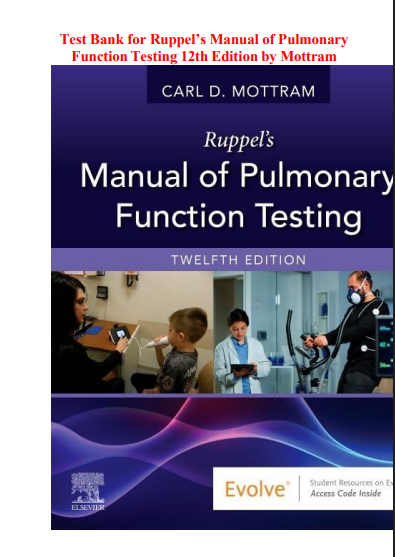
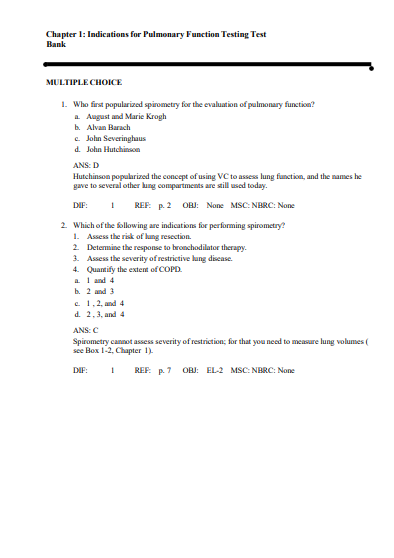

Pulmonary function testing is a subject built on precision. A tiny error in patient coaching, equipment calibration, or result interpretation can completely change how a test is read, and that read can shape a patient’s entire treatment plan. This is exactly why courses built around this textbook go far beyond simple definitions and demand real technical understanding of how each test works, what can go wrong, and how to interpret the results correctly. This test bank was built around that demand. It follows the chapter structure of Ruppel’s Manual of Pulmonary Function Testing, 12th Edition, by Carl D. Mottram, so you can review testing procedures, equipment principles, and interpretation skills the same structured, technical way the textbook teaches them.
Whether you are in a respiratory therapy program, preparing for the CRT or RRT credentialing exams, or reviewing pulmonary function testing before working in a PFT lab, this resource is designed to help you build the precise, detail-oriented understanding this specialty consistently requires.
What This Test Bank Covers
The question sets are organized to match the topics found throughout the textbook, including:
- Basic pulmonary function concepts, including lung volumes and capacities
- Spirometry procedures, patient coaching techniques, and quality control criteria
- Lung volume measurement methods, including body plethysmography and gas dilution techniques
- Diffusing capacity testing and its clinical applications
- Bronchoprovocation and bronchodilator response testing
- Arterial blood gas analysis and its relationship to pulmonary function
- Cardiopulmonary exercise testing principles
- Infection control and equipment calibration standards in the PFT lab
- Interpretation strategies for distinguishing obstructive versus restrictive patterns
- Pediatric and specialized pulmonary function testing considerations
- Quality assurance and troubleshooting common testing errors
Each section includes a mix of multiple-choice, matching, and interpretation-based questions, since these formats closely reflect how pulmonary function testing courses and credentialing exams are structured.
Why Students Use a Test Bank Like This
Pulmonary function testing exams rarely stop at asking you to define a term like FEV1 or TLC. They ask you to interpret a full set of results, recognize when a test was performed incorrectly, or identify what pattern a specific combination of values represents. Practicing with well-written questions helps you:
- Build confidence interpreting spirometry, lung volume, and diffusing capacity results together
- Practice recognizing technical errors that can invalidate a test and require repeating it
- Get comfortable distinguishing obstructive, restrictive, and mixed patterns from a full data set
- Strengthen your understanding of quality control standards used in accredited PFT labs
- Reduce exam anxiety by practicing the same interpretation-based reasoning used on credentialing exams
Many students say pulmonary function testing is harder than it looks, because it is not just about memorizing normal values, it is about recognizing when a result does not fit the expected pattern and figuring out why. Regular, chapter-based practice is one of the most effective ways to build that troubleshooting mindset before it matters in a real PFT lab.
What Makes This Test Bank Different
This test bank is built around complete explanations, not shortcut answer keys. Every question includes a full rationale that explains why the correct interpretation or action is accurate, and why each incorrect option reflects a different pattern, a technical error, or a misunderstanding of the underlying physiology. This mirrors how pulmonary function testing exams are typically written, since incorrect choices usually describe a real, plausible pattern, just not the one that matches the data given.
Questions are grouped by chapter and by testing category, so you can focus your review exactly where you need it, whether that is a single topic like diffusing capacity before a quiz, or a full review before a comprehensive or credentialing exam. It works well as a companion to assigned readings, a self-check before lab practicals, or a structured review before exam day.
Sample Questions
Question 1
A patient’s spirometry results show a reduced FEV1/FVC ratio, with a normal FVC and a significantly reduced FEV1. Which pattern does this represent?
A. Restrictive pattern
B. Obstructive pattern
C. Mixed pattern
D. Normal pulmonary function
Correct Answer: B
Rationale: An obstructive pattern is characterized by a reduced FEV1/FVC ratio, since airflow limitation causes the FEV1 to drop more significantly than the FVC. A normal FVC combined with a reduced FEV1 is a classic hallmark of obstructive lung disease, such as COPD or asthma. A restrictive pattern typically shows a reduced FVC with a normal or even increased FEV1/FVC ratio, which does not match the values described here. A mixed pattern would show reductions in both FVC and the FEV1/FVC ratio together, which is not the case in this scenario. These values clearly fall outside the range expected for normal pulmonary function.
Question 2
During a spirometry test, the technologist notices the patient did not reach a plateau in the volume-time curve before stopping exhalation. What is the most appropriate next step?
A. Accept the test as valid and proceed to the next maneuver
B. Coach the patient to exhale longer and repeat the maneuver to obtain an acceptable curve
C. Discard the entire testing session without attempting further maneuvers
D. Adjust the reference equations to compensate for the incomplete exhalation
Correct Answer: B
Rationale: A volume-time curve that does not reach a plateau indicates the patient may not have fully exhaled, which can lead to an inaccurate FVC measurement. The appropriate response is to coach the patient further and repeat the maneuver to obtain a test that meets acceptability criteria, since accurate interpretation depends on a complete, technically sound effort. Accepting an incomplete curve as valid could lead to a misleading result. Discarding the entire session is an overcorrection, since repeating the maneuver with better coaching is often sufficient to obtain a valid test. Adjusting reference equations does not address the underlying technical problem and would not correct an inaccurate raw measurement.
Question 3
A patient’s pulmonary function results show a reduced total lung capacity (TLC) along with a normal FEV1/FVC ratio. Which pattern is most consistent with these findings?
A. Obstructive pattern
B. Restrictive pattern
C. Normal pulmonary function
D. Mixed obstructive-restrictive pattern
Correct Answer: B
Rationale: A restrictive pattern is characterized by a reduced total lung capacity, reflecting a decrease in overall lung volume, while the FEV1/FVC ratio typically remains normal or even slightly elevated, since airflow itself is not primarily obstructed. This combination points toward conditions that limit lung expansion, such as pulmonary fibrosis or chest wall disorders. An obstructive pattern would show a reduced FEV1/FVC ratio rather than a normal one, which does not match this scenario. Normal pulmonary function would not include a reduced TLC. A mixed pattern would show both a reduced FEV1/FVC ratio and reduced lung volumes together, which is not what is described here.
Question 4
Which quality control practice is essential for maintaining accurate spirometry results in a pulmonary function testing lab?
A. Calibrating the spirometer only once, at the time of purchase
B. Performing daily calibration checks using a calibration syringe
C. Skipping calibration checks if the equipment appears to be working normally
D. Calibrating the equipment only after a patient result seems questionable
Correct Answer: B
Rationale: Daily calibration checks using a calibration syringe are a standard quality control practice in pulmonary function testing labs, helping to confirm that the equipment is measuring volume accurately before it is used for patient testing. This proactive approach helps catch equipment drift or malfunction before it affects patient results. Calibrating only once at purchase does not account for equipment changes or drift over time. Skipping calibration checks based on appearance alone is unsafe, since equipment can malfunction without obvious external signs. Waiting until a result seems questionable to calibrate means inaccurate results may already have been reported and used in patient care decisions before the problem was caught.
Question 5
A patient undergoes bronchodilator response testing. After administration of a bronchodilator, the FEV1 improves by 14% and 250 mL compared to the pre-bronchodilator value. How should this result be interpreted?
A. This does not meet criteria for a significant bronchodilator response
B. This meets criteria for a significant, positive bronchodilator response
C. This result indicates the test must be repeated due to an error
D. This result indicates a restrictive pattern rather than an obstructive one
Correct Answer: B
Rationale: A significant bronchodilator response is generally defined as an improvement in FEV1 of at least 12% and at least 200 mL compared to the pre-bronchodilator value. Since this patient’s results exceed both thresholds, this represents a positive, clinically significant response, suggesting reversible airway obstruction, which is often seen in conditions like asthma. Option A is incorrect, since the improvement described does meet the established criteria for significance. Option C is unnecessary, since a result meeting these criteria is not itself evidence of a testing error. Option D is inaccurate, since bronchodilator response testing evaluates reversibility of airflow obstruction, not the presence of a restrictive pattern.
Frequently Asked Questions
Is this test bank the same as the official instructor materials from the publisher?
This test bank is an independently prepared study resource built to help students review the topics covered in the 12th edition of Ruppel’s Manual of Pulmonary Function Testing. It is intended as a self-study companion and is not distributed by the publisher.
Is this test bank helpful for CRT or RRT credentialing exam preparation?
The questions are written in an interpretation-based style similar to credentialing exam questions, with an emphasis on recognizing testing patterns, technical errors, and quality control standards, all of which are heavily tested areas in pulmonary function testing.
Does it cover every chapter of the textbook?
Yes, the questions are organized by chapter and testing category, following the general topic order of the 12th edition, from foundational pulmonary function concepts through specialized and pediatric testing considerations.
What question formats are included?
Most questions are multiple-choice, with some matching and interpretation-based items, since these formats are common in pulmonary function testing coursework and on credentialing-style exams.
Do the answers include explanations, or just the correct letter?
Yes, every question includes a full rationale explaining why the correct interpretation or action is accurate and why the other options reflect a different pattern or technical issue.
Who is this test bank best suited for?
It is designed for respiratory therapy students, PFT lab technologists in training, and anyone preparing for the CRT or RRT credentialing exams who needs focused practice with pulmonary function testing interpretation.
How should I use this resource while studying?
A common approach is to read the assigned chapter first, then work through the related questions without checking the answers right away. Afterward, review the rationales closely, especially for missed questions, since understanding why a specific pattern or technical issue occurred matters more than memorizing the correct letter alone.
Can this replace reading the textbook?
No. This resource works best alongside the textbook, not instead of it. The textbook builds your foundational understanding of pulmonary function testing procedures and interpretation principles, while the test bank helps you practice applying that knowledge to realistic testing scenarios.
Is the content aligned specifically with the 12th edition?
Yes, the material follows the topics, terminology, and chapter organization used in the 12th edition of the textbook.
Is this useful for last-minute exam review?
Yes, many students use it as a focused review tool in the days before an exam, since the chapter-based organization makes it easy to target specific testing categories quickly, rather than reviewing the entire book at once.


Kimsh –
Great tool for reviewing concepts
Annen Harry –
Improved my confidence before exams.
Maximevanmol –
Very effective for nursing practice