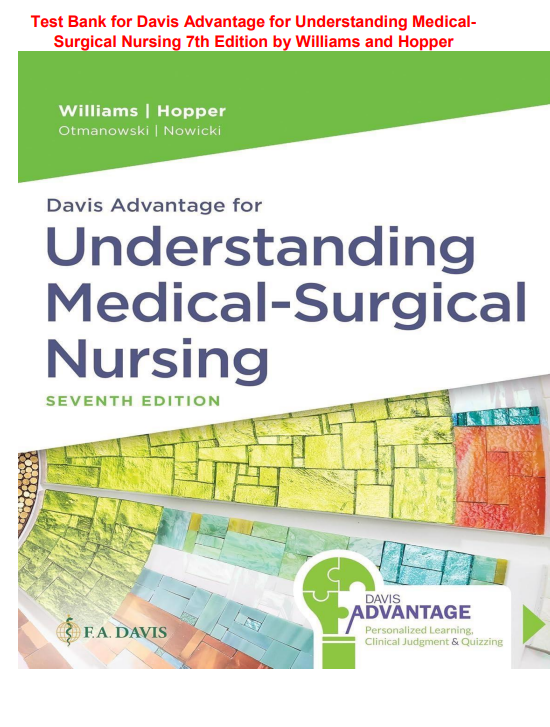
Medical-surgical nursing covers more ground than almost any other nursing subject. One week you are studying cardiac disorders, the next you are learning about wound care, then suddenly you are expected to know renal failure, respiratory emergencies, and postoperative complications all at once. It is a lot to hold in your head, and it is easy to feel like you are drowning in content instead of actually learning it. This test bank was created to help with exactly that problem. It follows the chapter structure of Davis Advantage for Understanding Medical-Surgical Nursing, 7th Edition, by Linda S. Williams and Paula D. Hopper, so you can review body system by body system, disorder by disorder, in a way that actually mirrors how the course is taught.
Whether you are working through an associate or bachelor’s nursing program, reviewing for a med-surg course exam, or preparing for the NCLEX-RN, this resource is built to help you practice clinical reasoning, not just memorization. Every question is written to reflect the kind of decision-making a nurse actually uses at the bedside.
What This Test Bank Covers
The questions are organized to match the topics found throughout the textbook, including:
- Foundations of medical-surgical nursing, including the nursing process and patient-centered care
- Fluid, electrolyte, and acid-base balance
- Perioperative nursing care, from pre-op teaching through post-op recovery
- Cardiovascular disorders, including heart failure, coronary artery disease, and dysrhythmias
- Respiratory disorders, including COPD, pneumonia, and respiratory failure
- Renal and urinary system disorders, including acute kidney injury and chronic kidney disease
- Gastrointestinal disorders, including bowel obstruction, GI bleeding, and liver disease
- Endocrine disorders, including diabetes mellitus and thyroid dysfunction
- Musculoskeletal and neurological disorders, including stroke and spinal cord injury
- Immune, hematologic, and oncologic conditions
- Pain management, infection control, and end-of-life care principles
Each section includes a mix of multiple-choice, select-all-that-apply, and prioritization-style questions, since these formats are heavily used in medical-surgical nursing exams and on licensure-style tests.
Why Students Use a Test Bank Like This
Med-surg exams are notorious for asking questions that require you to combine several pieces of information at once. A single question might expect you to recognize a symptom, connect it to a diagnosis, and then decide what the nurse should do first, all in one scenario. Practicing with well-written questions helps you:
- Recognize early warning signs and complications tied to specific disorders
- Build confidence with prioritization questions, which make up a large share of med-surg exams
- Practice connecting pathophysiology to nursing interventions instead of memorizing facts in isolation
- Get comfortable with lab values, medication considerations, and post-procedure care questions
- Reduce exam anxiety by practicing the same scenario-based question style used in course exams and licensure testing
Many students say medical-surgical nursing is hard not because the individual facts are difficult, but because there are so many of them, spread across so many body systems. Repeated practice with organized, chapter-based questions is one of the most effective ways to keep everything straight.
What Makes This Test Bank Different
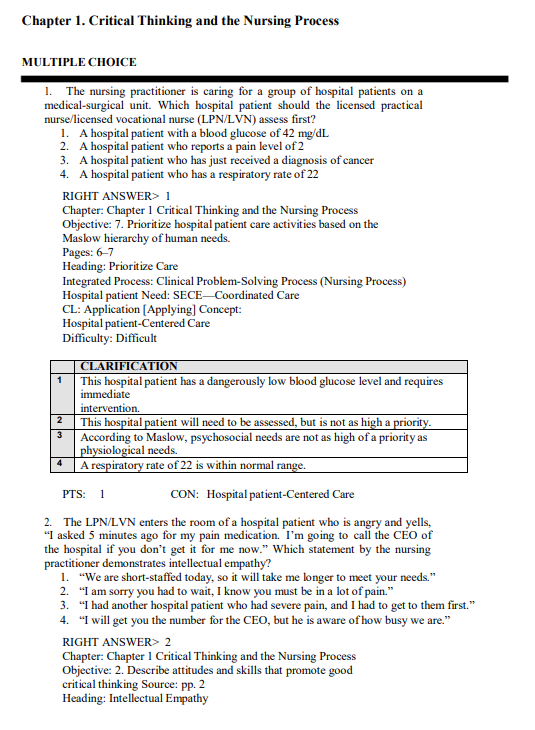
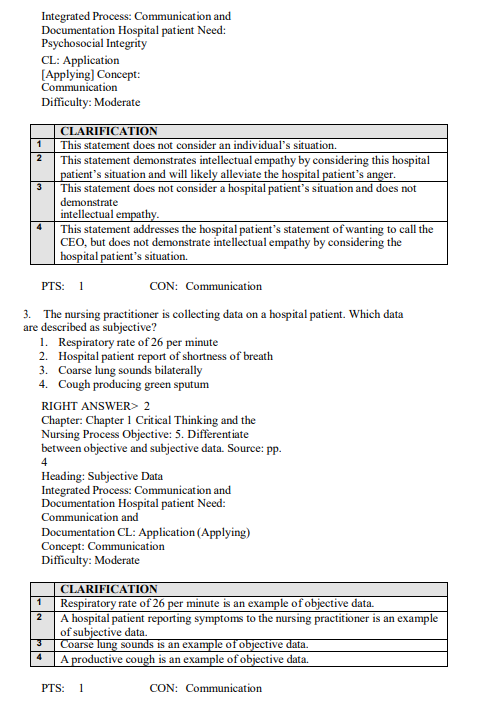
This test bank prioritizes understanding over shortcuts. Every question includes a full rationale that explains not just which answer is correct, but why the other choices are incorrect, unsafe, or simply not the priority in that clinical situation. This mirrors how med-surg exams are actually written, since incorrect answers are usually plausible-sounding rather than obviously wrong.
Questions are grouped by chapter and body system, so you can focus your review exactly where you need it, whether that is a single disorder before a quiz or a full-system review before a unit exam. It works well as a companion to assigned readings, a self-check before clinical rotations, or a structured review before a comprehensive final.
Sample Questions
Question 1
A nurse is caring for a patient with heart failure who has gained 3 pounds in the last 24 hours. Which action should the nurse take first?
A. Encourage the patient to increase oral fluid intake
B. Notify the healthcare provider of the weight change
C. Document the weight and reassess in 24 hours
D. Restrict the patient’s sodium intake immediately without further assessment
Correct Answer: B
Rationale: A weight gain of 3 pounds in 24 hours in a patient with heart failure suggests fluid retention and possible worsening heart failure, which requires prompt provider notification so treatment, such as diuretic adjustment, can be considered. Option A is incorrect and potentially harmful, since increasing fluid intake would worsen fluid overload. Option C delays necessary action, since waiting 24 hours could allow the patient’s condition to decline further. Option D is not within independent nursing judgment to initiate without a provider order, and jumping to a specific intervention before reporting the finding skips an important step in the process.
Question 2
A patient returns from surgery two hours ago and reports sudden, severe pain unrelieved by prescribed medication, along with a cool, pale extremity distal to the surgical site. What should the nurse suspect?
A. Normal postoperative discomfort
B. Compartment syndrome
C. Anxiety related to surgery
D. Delayed onset of anesthesia
Correct Answer: B
Rationale: Sudden, severe pain that is not relieved by medication, combined with a cool, pale extremity, are classic warning signs of compartment syndrome, a serious complication involving increased pressure within a muscle compartment that can compromise blood flow and nerve function. This requires urgent assessment and provider notification, since delayed treatment can lead to permanent tissue damage. Option A is incorrect because normal postoperative pain typically responds to prescribed analgesics. Option C does not account for the specific physical findings of pallor and coolness. Option D is unrelated, since anesthesia effects would not typically cause this combination of severe pain and vascular changes in one limb.
Question 3
Which laboratory finding would the nurse expect in a patient with chronic kidney disease?
A. Decreased blood urea nitrogen (BUN) and creatinine
B. Elevated blood urea nitrogen (BUN) and creatinine
C. Decreased potassium level
D. Elevated hemoglobin and hematocrit
Correct Answer: B
Rationale: In chronic kidney disease, the kidneys lose their ability to filter waste products effectively, causing BUN and creatinine levels to rise above normal. Option A describes the opposite of what typically occurs. Option C is incorrect, since chronic kidney disease often causes potassium levels to rise, not fall, due to reduced excretion. Option D is also incorrect, since chronic kidney disease commonly leads to anemia from decreased erythropoietin production, which lowers hemoglobin and hematocrit rather than raising them.
Question 4
A patient with chronic obstructive pulmonary disease (COPD) is receiving oxygen therapy. Which oxygen flow rate consideration is most important for the nurse to keep in mind?
A. High-flow oxygen should always be used to fully correct hypoxemia
B. Oxygen should be titrated carefully to avoid suppressing the patient’s respiratory drive
C. Oxygen therapy is not necessary unless the patient is in acute distress
D. Oxygen should be withheld until arterial blood gas results are available
Correct Answer: B
Rationale: In some patients with chronic COPD, the primary drive to breathe can become more dependent on low oxygen levels rather than rising carbon dioxide levels, which is the typical stimulus in healthy individuals. Administering high-flow oxygen without careful titration can blunt this respiratory drive and lead to hypoventilation. Option A is incorrect and can be dangerous in this population. Option C is inaccurate, since supplemental oxygen is often part of ongoing COPD management, not just acute distress. Option D is impractical and unsafe, since a hypoxic patient may need supplemental oxygen before lab results return, though it should still be given cautiously and monitored closely.
Question 5
A patient is diagnosed with diabetic ketoacidosis (DKA). Which finding would the nurse expect to see?
A. Blood glucose below 70 mg/dL
B. Fruity-smelling breath and Kussmaul respirations
C. Slow, shallow respirations
D. Elevated blood pH above normal range
Correct Answer: B
Rationale: Diabetic ketoacidosis occurs when the body breaks down fat for energy due to insufficient insulin, producing ketones that lower blood pH and cause metabolic acidosis. The body compensates through Kussmaul respirations, which are deep and rapid breaths that help eliminate carbon dioxide, along with a distinct fruity odor on the breath from the ketones. Option A is incorrect, since DKA is associated with hyperglycemia, not hypoglycemia. Option C describes the opposite breathing pattern from what actually occurs in DKA. Option D is incorrect, since DKA causes acidosis, meaning the blood pH drops below normal rather than rising above it.
Frequently Asked Questions
Is this test bank the same as the official instructor materials from the publisher?
This test bank is an independently prepared study resource built to help students review the topics covered in the 7th edition of Davis Advantage for Understanding Medical-Surgical Nursing. It is intended as a self-study companion and is not distributed by the publisher.
Is this test bank helpful for NCLEX-RN preparation?
The questions are written in a scenario-based style similar to licensure-exam questions, with an emphasis on prioritization, clinical reasoning, and recognizing complications, all of which are heavily tested areas in medical-surgical nursing.
Does it cover every chapter of the textbook?
Yes, the questions are organized by chapter and body system, following the general topic order of the 7th edition, from foundational concepts through specific disorders across all major body systems.
What question formats are included?
Most questions are multiple-choice, with some select-all-that-apply and prioritization-style items, since these formats are common in medical-surgical nursing courses and on licensure-style exams.
Do the answers include explanations, or just the correct letter?
Yes, every question includes a full rationale explaining why the correct answer is best and why the other options are incorrect, unsafe, or not the immediate priority.
Who is this test bank best suited for?
It is designed for nursing students taking a medical-surgical nursing course, as well as anyone reviewing core med-surg content ahead of the NCLEX-RN or a certification exam.
How should I use this resource while studying?
A common approach is to read the assigned chapter first, then answer the related questions without checking the answers right away. Afterward, review the rationales closely, especially for any missed questions, since understanding the underlying pathophysiology matters more than memorizing the correct letter.
Can this replace reading the textbook?
No. This resource works best alongside the textbook, not instead of it. The textbook builds your foundational understanding of each body system and disorder, while the test bank helps you practice applying that knowledge to realistic clinical scenarios.
Is the content aligned specifically with the 7th edition?
Yes, the material follows the topics, terminology, and chapter organization used in the 7th edition of the textbook.
Is this useful for last-minute exam review?
Yes, many students use it as a focused review tool in the days before an exam, since the chapter-based organization makes it easy to target specific systems or disorders quickly, rather than reviewing the entire book at once.


Amijw –
worth every penny
Frank –
Highly recommend it
nakiadraharris –
Very good!
peytondavid12 –
Highly relevant and easy to follow, simplified key topics and is extremely helpful for last-minute revision.Very recommendable
Mathivhathendo –
Very nice summary, this helps a lot!!
Silviazeng –
A huge help for in studying
Meg –
The test bank is consistent and of superior quality. Well written and logical to follow
Moses –
Clear, accurate, and extremely helpful for exam preparation
Anne –
Easy to follow and understand.
Ivy –
Great questions with useful explanations
Awilkerson –
Very useful for nursing preparation.
Pamela White –
Very helpful for nursing exam preparation.