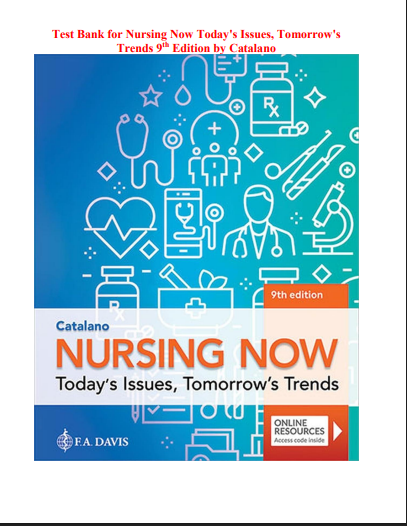
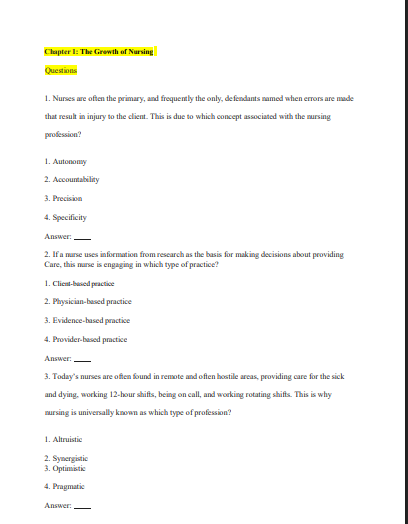
Most of nursing school is built around patients: how to assess them, treat them, and keep them safe. Nursing Now: Today’s Issues, Tomorrow’s Trends covers a different, equally important side of the profession, the history, laws, ethics, and workplace realities that shape how nurses actually practice. This test bank was designed as a companion to that material. It mirrors the chapter layout of the 9th edition, written by Joseph T. Catalano, so you can practice the professional-issues content in the same order your course covers it.
If you are taking an issues and trends class, preparing for the professional-practice content on the NCLEX-RN, or simply want to walk into your final semester with a stronger grip on where nursing is headed as a field, this set of practice questions is built to get you there.
Topics Covered in This Test Bank
Question sets follow the book’s organization and touch on:
- How the nursing profession developed historically and how that history still shapes it today
- Entry-into-practice debates and the different educational routes into nursing
- Licensure requirements, credentialing bodies, and practice regulation
- Legal exposure for nurses, including negligence, malpractice, and consent issues
- Ethical frameworks nurses use to work through difficult decisions
- Nursing theory and how it connects to day-to-day practice
- Workforce challenges, including burnout, turnover, and the shortage of working nurses
- Nurses’ involvement in health policy and political advocacy
- The expanding role of health IT and informatics in nursing
- Diversity and cultural awareness as part of professional competence
- Career trajectories, leadership pathways, and where the profession is trending next
Question formats include multiple-choice, select-all-that-apply, and short scenario items, matching the mix typically used in issues and trends coursework and licensure-style exams.
Why This Kind of Practice Helps
This course tends to trip students up not because the material is dense, but because it asks you to apply a concept rather than recite it. Instead of “define negligence,” you might get a workplace scenario and be asked to identify what legal or ethical issue is actually at play. Working through practice questions like these helps you:
- Tell apart similar-sounding legal terms, like negligence versus malpractice versus battery
- Apply ethical principles (autonomy, justice, beneficence, and others) to situations that don’t come with obvious answers
- Recognize appropriate professional responses to staffing shortages, documentation issues, or workplace conflict
- Connect nursing’s history and theoretical foundations to how the profession functions now
- Get faster at the applied reasoning style this course and the NCLEX use
A lot of students describe this class as feeling less concrete than clinical courses, since there’s no single “correct” physical assessment finding to fall back on. Repeated exposure to scenario-based questions is one of the more reliable ways to build comfort with that kind of judgment call.
What’s Different About This Set
Rather than a bare list of correct letters, each question here comes with a full explanation covering why the right answer fits and why the others don’t quite hold up, whether that’s a mismatched legal term, an ethical principle that doesn’t actually apply, or an outdated view of a workforce trend. That is deliberate, since issues and trends exams tend to offer several believable-sounding choices rather than one obviously wrong option among throwaways.
Everything is grouped by chapter and topic area, so you can drop into whatever section you’re covering that week rather than working through material you’ve already mastered. It’s built to sit alongside your reading, function as a pre-class warm-up, or serve as a condensed review pass before a bigger exam.
Sample Questions
Question 1
A nurse gives the wrong medication dose because of an error in transcribing the order, and the patient is harmed as a result. What legal concept applies here?
A. Battery
B. Negligence
C. Assault
D. Defamation
Correct Answer: B
Rationale: This scenario describes a failure to meet the expected standard of care, an unintentional error that led to patient harm, which is the definition of negligence. Battery involves unauthorized physical contact, and this medication was given as part of intended treatment, not without consent, so that term doesn’t fit. Assault involves the threat of harmful contact, not an unintentional error. Defamation concerns false statements that damage someone’s reputation, which has nothing to do with a medication mistake.
Question 2
A dying patient has clearly stated they want no further aggressive treatment, but their family is pushing to continue it anyway. Which ethical principle most strongly supports going along with the patient’s own decision?
A. Beneficence
B. Justice
C. Autonomy
D. Nonmaleficence
Correct Answer: C
Rationale: Autonomy protects a patient’s right to direct their own care, including refusing treatment, even when loved ones disagree with that choice. Beneficence is about acting in the patient’s best interest, but what counts as “best” is exactly what’s in dispute here, so it doesn’t resolve the conflict the way autonomy does. Justice deals with fair distribution of resources, which isn’t the issue in this family disagreement. Nonmaleficence is about avoiding harm broadly, but the principle that most directly backs the patient’s right to make this call is autonomy.
Question 3
Current workforce research points to which combination of factors as most responsible for the ongoing nursing shortage?
A. Too many nursing graduates entering the workforce each year
B. An aging nurse population combined with high burnout and turnover
C. Declining demand for nursing services nationwide
D. A surplus of qualified nursing faculty
Correct Answer: B
Rationale: The shortage is largely attributed to a wave of nurses reaching retirement age alongside high rates of burnout pushing others out of the field early, both shrinking the available workforce while patient demand keeps climbing. An oversupply of graduates isn’t accurate, since nursing programs are often capacity-limited rather than overproducing. Demand for nursing care is rising, not falling, particularly as the population ages. And a faculty surplus contradicts what’s actually reported, since faculty shortages are frequently cited as a bottleneck limiting how many students programs can even admit.
Question 4
A charge nurse has to decide how to divide limited staff across several short-staffed units during a demanding shift. Which ethical principle is most directly relevant to that decision?
A. Fidelity
B. Autonomy
C. Veracity
D. Justice
Correct Answer: D
Rationale: Justice concerns fair allocation of limited resources, which is precisely the situation this charge nurse faces when dividing scarce staffing across competing needs. Autonomy is about an individual patient’s right to make care decisions, not resource distribution across units. Veracity is about honesty in communication, unrelated to staffing math. Fidelity concerns keeping commitments and professional loyalty, which, while generally relevant to nursing, doesn’t capture the resource-allocation nature of this specific decision the way justice does.
Question 5
Which best describes what nursing informatics actually involves in current practice?
A. It focuses only on billing and insurance-related tasks
B. It combines nursing knowledge with information technology to support patient care and data use
C. It has mostly been taken over by non-nursing administrative staff
D. It’s relevant only to nurses in dedicated research positions
Correct Answer: B
Rationale: Nursing informatics blends clinical nursing knowledge with IT and data skills to improve things like documentation, clinical decision support, and overall care quality, and it’s a role that’s grown substantially in recent years. Limiting it to billing undersells its actual scope, since it touches everything from electronic health records to quality improvement initiatives. It hasn’t been displaced by administrative staff; if anything, dedicated informatics roles have expanded. And it isn’t confined to research settings, it shows up across clinical, administrative, and educational nursing roles alike.
Frequently Asked Questions
Is this the same thing as the publisher’s official instructor test bank?
No. This is an independently written study resource meant to help you review the material covered in the 9th edition of Nursing Now: Today’s Issues, Tomorrow’s Trends. It’s built as a self-study tool and isn’t distributed by the publisher.
Will this help with the professional-practice portion of the NCLEX-RN?
The scenario-based format mirrors how licensure exams tend to test legal and ethical concepts, so working through it can strengthen the same reasoning skills tested on that part of the NCLEX.
Is every chapter of the book covered?
Yes, questions follow the 9th edition’s chapter sequence, from the history of the profession through to current technology and workforce trends.
What kinds of questions are in it?
Mostly multiple-choice, with some select-all-that-apply and short scenario-based items, matching the format most issues and trends instructors tend to use.
Do I get explanations, or just an answer key?
Every question includes a full explanation of why the correct choice fits and why the other options don’t, so you’re learning the reasoning, not just memorizing letters.
Who is this meant for?
Anyone taking a nursing issues and trends course, or reviewing professional, legal, and ethical concepts before an exam or before sitting for the NCLEX-RN.
What’s a good way to use this while studying?
Read the assigned chapter, then attempt the matching questions before checking answers. Go back through the rationales for anything you missed, since understanding why a concept applies matters more than memorizing the right letter.
Should this replace reading the textbook?
No, it works better as a supplement. The textbook gives you the conceptual foundation; this gives you a way to practice applying it.
Does the content match the 9th edition specifically?
Yes, it follows the terminology, topics, and chapter structure of the 9th edition.
Is it useful right before an exam?
Yes, since it’s organized by chapter and topic, it’s easy to zero in on a specific area, like legal issues or workforce trends, without rereading the whole book


Annen Harry –
Excellent resource for exam practice.
Joy James –
Questions closely match exam topics.
Tonny Jakes –
Helpful, organized, and easy to use