

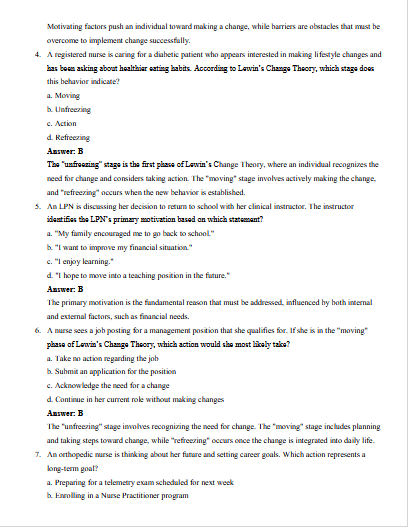
Moving from LPN to RN is not just about learning new clinical skills. It is a shift in how you think, how you make decisions, and how much responsibility you carry as a nurse. That shift in mindset is exactly what trips up a lot of bridge students on exams, because the questions are not only testing what you know, but how you now apply it with a broader scope of practice. This test bank was built around that challenge. It follows the chapter structure of LPN to RN Transitions, 5th Edition, by Lora Claywell, and gives you organized, realistic practice questions to help you prepare for course exams, NCLEX-RN style content, and the everyday decision-making expected of a registered nurse.
Whether you are enrolled in an LPN to RN bridge program, reviewing before an accelerated pathway exam, or simply want to strengthen your understanding of the RN scope of practice, this resource is designed to help you think the way the exam wants you to think: with a wider lens, stronger prioritization skills, and a clear understanding of where LPN and RN roles differ.
What This Test Bank Covers
The questions are organized to match the topics found throughout the textbook, including:
- The history and evolution of nursing education and licensure
- Differences in scope of practice between the LPN and RN roles
- Role transition theory and adapting to increased responsibility
- Critical thinking, clinical judgment, and the nursing process at the RN level
- Delegation and supervision of LPNs, nursing assistants, and other team members
- Legal and ethical responsibilities of the registered nurse
- Leadership, management, and communication within the healthcare team
- Time management, prioritization, and organizational skills for RN practice
- Professional development, lifelong learning, and continuing education
- Preparing for licensure and transitioning into RN-level clinical roles
Each section includes a mix of multiple-choice, select-all-that-apply, and prioritization-style questions, since these formats are commonly used in transition courses and on licensure-style exams.
Why Students Use a Test Bank Like This
Bridge students often say the hardest part of an LPN to RN program is not the clinical content itself, since many students already have real-world nursing experience. The harder part is learning to answer questions the way an RN is expected to think: seeing the bigger picture, prioritizing across multiple patients, and knowing when a task should be delegated rather than done personally. Practicing with well-written questions helps you:
- Recognize the difference between LPN-level and RN-level responsibilities in a given scenario
- Build confidence with delegation and assignment questions, which are heavily tested in transition courses
- Strengthen prioritization skills when managing more than one patient at a time
- Get comfortable applying leadership and communication concepts to realistic team situations
- Reduce exam anxiety by practicing the exact style of scenario-based questions used in RN-level testing
Many students coming from an LPN background already know the “what” of nursing care. This test bank is designed to help you master the “who does what, and who decides,” which is where a lot of scope-of-practice questions are won or lost.
What Makes This Test Bank Different
This test bank is built around depth, not just quantity. Every question includes a complete rationale explaining not only why the correct answer is right, but why the other options either fall within LPN scope, are unsafe, or are not the best use of RN judgment in that moment. This mirrors how transition course exams are usually structured, since the “almost right” answer in a delegation or prioritization question is very often the wrong one.
Questions are grouped by chapter in a simple, easy-to-navigate format, so you can review by topic instead of searching through unrelated content. It works well alongside assigned readings, as a self-check before clinical rotations, or as a focused review before a unit or comprehensive exam.
Sample Questions
Question 1
The RN is making patient assignments for the shift. Which task is most appropriate to delegate to an LPN?
A. Completing the initial admission assessment for a new patient
B. Administering a scheduled oral medication to a stable patient
C. Developing the patient’s individualized plan of care
D. Providing discharge teaching for a patient with a new diabetes diagnosis
Correct Answer: B
Rationale: Administering routine, scheduled medications to a stable patient generally falls within the LPN scope of practice in most states and is an appropriate task to delegate. Initial admission assessments, care plan development, and complex discharge teaching require the broader clinical judgment associated with RN-level practice, since these tasks involve interpreting data, synthesizing a plan of care, and making independent clinical decisions. Delegating these tasks to an LPN would exceed the typical scope of LPN practice and could compromise patient safety.
Question 2
An RN is transitioning from an LPN role and is asked to prioritize care for four patients at the start of a shift. Which patient should the RN assess first?
A. A patient scheduled for routine wound care in one hour
B. A patient who reports new onset shortness of breath
C. A patient waiting for discharge paperwork to be completed
D. A patient requesting a warm blanket
Correct Answer: B
Rationale: New onset shortness of breath can indicate a serious change in respiratory or cardiac status and requires immediate assessment to rule out an emergency. Prioritization at the RN level relies on airway, breathing, and circulation concerns being addressed before non-urgent needs. Routine wound care, discharge paperwork, and comfort requests like a warm blanket are all important, but none of them represent an acute change in condition, so they can wait until the patient with the new symptom has been evaluated.
Question 3
Which statement best reflects a key difference between LPN and RN scope of practice regarding the nursing process?
A. LPNs and RNs have identical responsibilities within the nursing process.
B. LPNs may contribute data and implement care, while RNs are responsible for assessment, analysis, planning, and evaluation.
C. LPNs are responsible for all five steps of the nursing process independently.
D. RNs are only responsible for documentation, while LPNs manage direct patient care.
Correct Answer: B
Rationale: LPNs typically contribute to patient care by collecting data and carrying out established interventions, but the RN holds primary responsibility for the full nursing process, including comprehensive assessment, developing nursing diagnoses, creating the plan of care, and evaluating outcomes. This reflects the broader scope of independent clinical judgment expected at the RN level. Option A is incorrect because the two roles are not identical in scope. Option C incorrectly expands LPN responsibility beyond what is typically permitted. Option D misrepresents both roles, since RNs are involved in direct care as well as the full nursing process, not documentation alone.
Question 4
A newly transitioned RN feels unsure about taking on a charge nurse role for the first time. According to role transition theory, which statement best describes this experience?
A. This discomfort is a sign the nurse is not ready for RN-level responsibility.
B. Role transition often includes a period of uncertainty as new responsibilities are integrated.
C. Nurses who feel unsure should avoid leadership roles permanently.
D. Role transition typically happens instantly once licensure is obtained.
Correct Answer: B
Rationale: Role transition theory describes moving into an expanded nursing role as a process, not a single event. It is common and expected for nurses to experience uncertainty, self-doubt, or a learning curve as they adjust to new responsibilities such as leadership or increased clinical autonomy. This discomfort does not indicate a lack of readiness; it reflects a normal stage of professional growth. Option A pathologizes a normal experience. Option C draws an unnecessary and inaccurate conclusion. Option D misrepresents how role transition actually works, since it unfolds gradually with experience and support rather than happening immediately.
Question 5
An RN discovers that an LPN on the team performed a task outside their legal scope of practice. What is the RN’s most appropriate initial action?
A. Ignore the incident since the task was completed successfully.
B. Report the incident according to facility policy and address it with the LPN directly.
C. Immediately terminate the LPN from the unit.
D. Wait to see if the issue happens again before taking any action.
Correct Answer: B
Rationale: When a scope-of-practice violation occurs, the RN has a professional and legal responsibility to address it promptly, both by following the facility’s reporting procedures and by communicating directly with the staff member involved. This protects patient safety and ensures the issue is documented and handled appropriately. Ignoring the incident, as in option A, disregards patient safety and legal accountability, regardless of the outcome. Option C is not typically within the RN’s authority and skips necessary steps such as investigation and facility policy. Option D delays necessary action and could allow an unsafe pattern to continue.
Frequently Asked Questions
Is this test bank the same as the official instructor materials from the publisher?
This test bank is an independently prepared study resource built to help students review the topics covered in the 5th edition of LPN to RN Transitions. It is intended as a self-study companion and is not distributed by the publisher.
Is this test bank helpful for NCLEX-RN preparation?
The questions are written in a similar style to licensure-exam questions, with an emphasis on prioritization, delegation, and scope-of-practice decisions, which are heavily tested areas for nurses transitioning into RN practice.
Does it cover every chapter of the textbook?
Yes, the questions are organized by chapter and follow the general topic order of the 5th edition, from role transition theory through leadership and professional development.
What question formats are included?
Most questions are multiple-choice, with some select-all-that-apply and prioritization-style items, since these formats are common in bridge programs and on licensure-style exams.
Do the answers include explanations, or just the correct letter?
Yes, every question includes a full rationale explaining why the correct answer is best and why the other options fall short, whether due to scope-of-practice limits, safety concerns, or incorrect prioritization.
Who is this test bank best suited for?
It is designed for LPNs enrolled in a bridge or transition program, as well as anyone reviewing RN-level scope of practice, delegation, and prioritization concepts ahead of an exam.
How should I use this resource while studying?
A common approach is to read the assigned chapter first, then answer the related questions without checking the answers right away. Afterward, review the rationales closely, especially for missed questions, since understanding the reasoning matters more than memorizing the correct letter.
Can this replace reading the textbook?
No. This resource works best alongside the textbook, not instead of it. The textbook builds your understanding of role transition and RN-level responsibilities, while the test bank helps you practice applying that knowledge to realistic scenarios.
Is the content aligned specifically with the 5th edition?
Yes, the material follows the topics, terminology, and chapter organization used in the 5th edition of the textbook.
Is this useful for last-minute exam review?
Yes, many students use it as a focused review tool in the days before an exam, since the chapter-based organization makes it easy to target specific topics, like delegation or prioritization, quickly.


Reviews
There are no reviews yet.