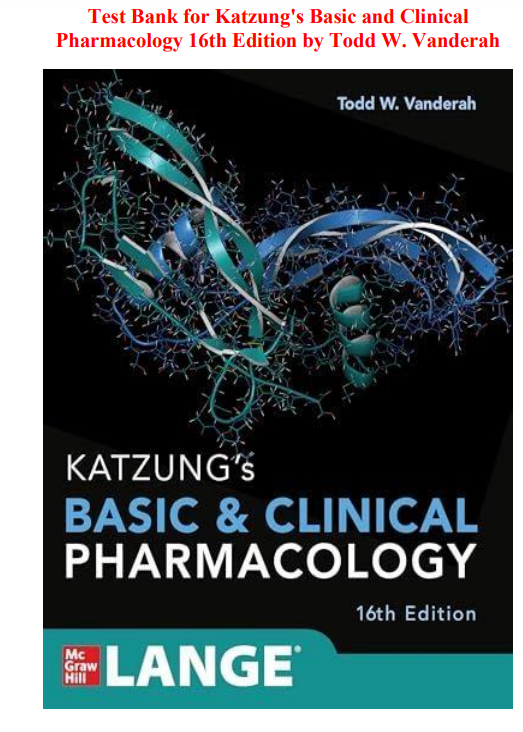
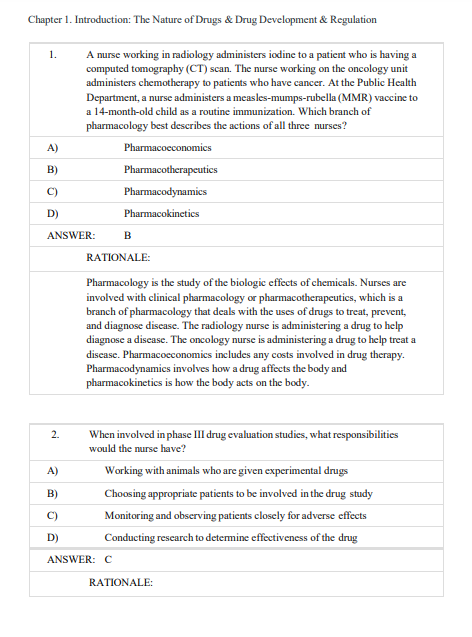
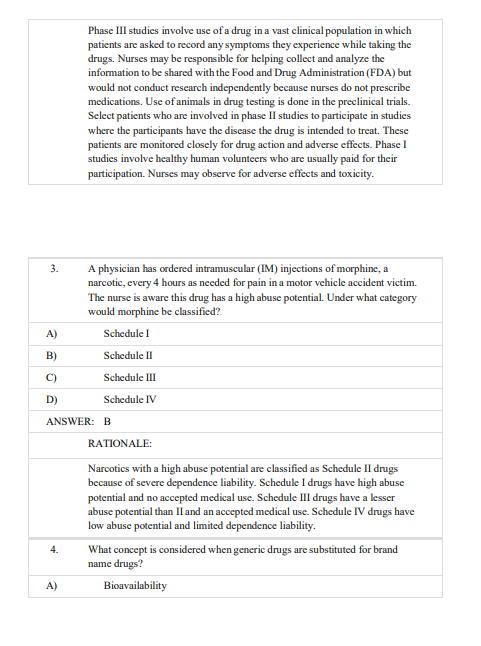
Katzung has been the go-to pharmacology reference for medical and pharmacy students for decades, and there’s a reason it’s stayed that way: it doesn’t let you get away with just knowing a drug’s name. It expects you to understand mechanism, receptor pharmacology, and clinical application together, and that’s exactly the level exams based on this text operate at. This test bank was built around that expectation. It follows the chapter structure of Katzung’s Basic and Clinical Pharmacology, 16th Edition, edited by Todd W. Vanderah, so your practice tracks the same depth and organization the textbook uses, from basic pharmacologic principles through organ-system pharmacology and clinical application.
Whether you’re a medical, pharmacy, or PA student working through core pharmacology, or reviewing before boards, this resource is designed to strengthen the mechanism-based reasoning these exams consistently demand, not just drug-name recall.
What’s Covered
Practice sets follow the textbook’s organization, including:
- Basic principles of pharmacokinetics and pharmacodynamics, including drug receptors and dose-response relationships
- Autonomic nervous system pharmacology, including cholinergic and adrenergic agents
- Cardiovascular pharmacology, including antihypertensives, antiarrhythmics, and heart failure medications
- Renal pharmacology and diuretic drug classes
- Drugs used in the treatment of asthma and other pulmonary conditions
- Central nervous system pharmacology, including sedative-hypnotics, antipsychotics, and antidepressants
- Anti-inflammatory and analgesic pharmacology, including NSAIDs and opioids
- Endocrine pharmacology, including thyroid, adrenal, and pancreatic hormone drugs
- Antimicrobial pharmacology, including antibacterial, antiviral, and antifungal mechanisms
- Chemotherapeutic drugs used in the treatment of cancer
- Toxicology principles and management of poisoning and drug overdose
- Special topics, including pharmacogenomics and drug development
Each section mixes multiple-choice, matching, and mechanism-based scenario questions, since these formats reflect how pharmacology courses using this text, and the licensing exams that draw from it, are typically structured.
Why Students Use a Test Bank Like This
Katzung-based exams rarely settle for “name the drug.” They tend to ask why a drug produces a particular effect at the receptor or enzyme level, or what happens if you combine two drugs that act on the same pathway. Practicing with well-written questions helps you:
- Connect a drug’s mechanism of action directly to its clinical effects and side effect profile
- Build confidence predicting the outcome of drug interactions based on shared pathways or receptors
- Practice distinguishing between drugs in the same class based on subtle mechanistic differences
- Get comfortable with questions that combine pharmacokinetics, pharmacodynamics, and clinical application in a single scenario
- Reduce exam anxiety by practicing the same integrative reasoning used on course exams and licensing exams
Many students say Katzung-level pharmacology is harder than a typical nursing pharmacology course because it goes a layer deeper, into receptor subtypes, signaling pathways, and detailed pharmacokinetic parameters. Regular, chapter-based practice is one of the most effective ways to keep that depth of detail organized instead of blurring together.
What Makes This Test Bank Different
This test bank is built around full mechanistic explanations, not shortcut answer keys. Every question includes a complete rationale that walks through the pharmacologic reasoning behind the correct answer, and explains why each incorrect option reflects a different mechanism, a different drug class, or an incomplete piece of the pharmacologic picture. This mirrors how Katzung-based exams are typically written, since incorrect choices usually describe a real drug or mechanism, just not the one that fits the specific question.
Questions are grouped by chapter and by pharmacologic system, so you can focus your review exactly where you need it, whether that’s a single topic like autonomic pharmacology before a quiz, or a full review before a comprehensive or licensing exam. It works well as a companion to assigned readings, a self-check before problem sets, or a structured review before exam day.
Sample Questions
Question 1
A drug binds irreversibly to an enzyme’s active site, permanently inactivating it. Increasing the concentration of the natural substrate does not restore enzyme activity. What type of inhibition does this describe?
A. Competitive inhibition
B. Noncompetitive, reversible inhibition
C. Irreversible inhibition
D. Allosteric activation
Correct Answer: C
Rationale: Irreversible inhibition occurs when a drug forms a permanent, typically covalent, bond with an enzyme’s active site, permanently disabling it regardless of how much substrate is present. Since the enzyme cannot regain function even with increased substrate, this rules out competitive inhibition, which can be overcome by adding more substrate. Noncompetitive, reversible inhibition would still allow enzyme activity to eventually return once the inhibitor dissociates, which does not match this scenario. Allosteric activation describes an increase in enzyme activity through a regulatory site, the opposite of the permanent inactivation described here.
Question 2
A patient taking a nonselective beta-blocker for hypertension also has asthma. Which effect of this medication is most concerning in this patient?
A. Increased heart rate due to beta-1 blockade
B. Bronchoconstriction due to beta-2 blockade
C. Increased renin release due to beta-1 blockade
D. Vasodilation due to beta-2 blockade
Correct Answer: B
Rationale: Nonselective beta-blockers block both beta-1 and beta-2 receptors. Beta-2 receptors in the bronchial smooth muscle normally promote bronchodilation, so blocking them can trigger bronchoconstriction, which is particularly dangerous in a patient with asthma. Beta-1 blockade decreases heart rate, not increases it, ruling out option A. Beta-1 blockade also decreases renin release rather than increasing it, since beta-1 receptors on the juxtaglomerular cells normally stimulate renin secretion. Beta-2 blockade causes vasoconstriction, not vasodilation, since beta-2 receptor activation is what normally promotes vascular smooth muscle relaxation.
Question 3
A patient overdoses on an opioid medication and presents with severe respiratory depression. Which mechanism explains how naloxone reverses this effect?
A. Naloxone increases hepatic metabolism of the opioid
B. Naloxone acts as a competitive antagonist at opioid receptors
C. Naloxone binds irreversibly to opioid receptors, permanently blocking them
D. Naloxone stimulates the respiratory center directly, independent of opioid receptors
Correct Answer: B
Rationale: Naloxone works as a competitive antagonist at opioid receptors, displacing the opioid from the receptor and blocking its effects, which reverses respiratory depression. Since it is competitive rather than irreversible, its effects can be overcome if enough opioid remains in the system, which is why repeat dosing is sometimes needed. Option A misrepresents the mechanism, since naloxone acts at the receptor level, not by altering hepatic metabolism. Option C is inaccurate, since naloxone’s binding is reversible and competitive, not permanent. Option D is incorrect, since naloxone’s effect on respiration is indirect, resulting from blocking opioid receptor activity rather than directly stimulating the respiratory center itself.
Question 4
Which pharmacokinetic parameter describes the fraction of an administered drug dose that reaches systemic circulation unchanged?
A. Volume of distribution
B. Bioavailability
C. Half-life
D. Clearance
Correct Answer: B
Rationale: Bioavailability specifically refers to the proportion of an administered drug dose that reaches systemic circulation in its active, unchanged form, which is influenced by factors like route of administration and first-pass metabolism. Volume of distribution describes how a drug disperses throughout body compartments relative to its plasma concentration, a different concept from the fraction reaching circulation. Half-life refers to the time it takes for a drug’s plasma concentration to decrease by half, which relates to elimination, not initial absorption. Clearance describes the rate at which a drug is removed from the body, also unrelated to the specific fraction absorbed into circulation.
Question 5
A patient taking a monoamine oxidase inhibitor (MAOI) is prescribed a sympathomimetic decongestant. What is the primary pharmacologic concern with this combination?
A. Decreased effectiveness of the decongestant due to enzyme induction
B. Accumulation of norepinephrine leading to a hypertensive crisis
C. Increased renal clearance of the MAOI, reducing its effectiveness
D. Decreased absorption of the decongestant in the presence of an MAOI
Correct Answer: B
Rationale: MAOIs inhibit the breakdown of norepinephrine and other monoamines. When combined with a sympathomimetic decongestant, which increases norepinephrine release or activity, the result can be a dangerous buildup of norepinephrine, leading to a hypertensive crisis. This interaction is a well-documented and clinically significant concern with MAOI therapy. Option A misrepresents the interaction, since the concern is excess norepinephrine effect, not enzyme induction reducing the decongestant’s effectiveness. Option C is inaccurate, since this interaction is not primarily about renal clearance of the MAOI itself. Option D is also inaccurate, since the concern is about excess sympathetic effect, not reduced drug absorption.
Frequently Asked Questions
Is this the same as the publisher’s official test bank?
No, this is an independently written study resource built to help you review the topics covered in the 16th edition of Katzung’s Basic and Clinical Pharmacology. It’s meant for self-study and isn’t distributed by the publisher.
Will this help with board exam preparation?
The mechanism-focused, integrative style mirrors the reasoning tested on many licensing and board exams, particularly questions involving receptor pharmacology, drug interactions, and clinical application of pharmacologic principles.
Does it cover every chapter of the textbook?
Yes, questions are organized by chapter and pharmacologic system, following the 16th edition’s structure from basic principles through organ-system pharmacology, chemotherapeutics, and toxicology.
What question formats are included?
Mostly multiple-choice, with some matching and mechanism-based scenario items, matching the format commonly used in pharmacology courses that rely on this text.
Are there explanations, or just answer letters?
Every question includes a full rationale explaining the pharmacologic reasoning behind the correct answer and why the other options reflect a different mechanism or drug class.
Who is this best suited for?
Medical, pharmacy, and PA students taking a pharmacology course built around this textbook, as well as anyone reviewing core mechanism-based pharmacology ahead of an exam.
How should I use this while studying?
Read the assigned chapter first, then work through the matching questions before checking answers. Review the rationales closely afterward, especially for anything missed, since understanding the mechanism behind an answer matters more than memorizing a letter.
Can this replace reading the textbook?
No, it’s meant to work alongside it. The textbook builds your foundational understanding of pharmacologic mechanisms and clinical application; the test bank gives you a way to practice applying that knowledge.
Is the content aligned specifically with the 16th edition?
Yes, it follows the topics, terminology, and chapter organization of the 16th edition.
Is this useful for last-minute review?
Yes, since it’s organized by chapter and system, it’s easy to target a specific pharmacologic area quickly rather than reviewing the entire book at once.


Gloria268 –
Perfect!
Johannes –
Extremely useful as I prepare for my finals.
Tonnyjakes –
Helpful resource during exam prep
Sim Vault1 –
Well-structured and easy to navigate