,

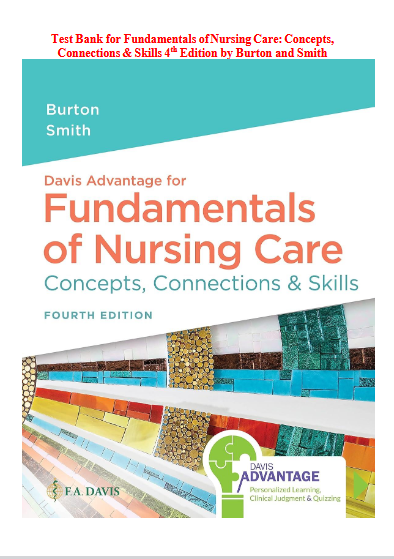
Test Bank for Fundamentals of Nursing Care: Concepts, Connections & Skills 4th Edition by Burton and Smith

Rated 5.00 out of 5 based on 7 customer ratings
(7 customer reviews)

$23.00

Test Bank for Fundamentals of Nursing Care: Concepts, Connections & Skills 4th Ed by Burton & Smith. Practice Q&A with rationales by chapter.

Fundamentals of nursing is where everything else in your nursing education begins. It is not just about memorizing vital sign ranges or the steps of a bed bath. It is about learning to think like a nurse for the first time, connecting basic concepts like safety, communication, and skill technique into one coherent way of caring for a patient. That is exactly why fundamentals exams can feel surprisingly tricky, even though the content seems “basic” on the surface. This test bank was built around that challenge. It follows the chapter structure of Fundamentals of Nursing Care: Concepts, Connections & Skills, 4th Edition, by Marilee LeBon Burton and Kathryn Smith, so you can review concept by concept and skill by skill, the same way the course is taught.

Whether you are just starting your nursing program, preparing for your first major skills exam, or reviewing before clinical rotations, this resource is designed to help you build the foundation that every later nursing course depends on.

What This Test Bank Covers

The questions are organized to match the topics found throughout the textbook, including:

  • The nursing process, critical thinking, and clinical judgment basics
  • Communication and the nurse-patient relationship
  • Health, wellness, and the concept of holistic patient-centered care
  • Safety, infection control, and standard precautions
  • Vital signs, physical assessment, and documentation
  • Basic patient care skills, including hygiene, mobility, and positioning
  • Nutrition, elimination, and fluid and electrolyte balance
  • Medication administration basics and safe practice principles
  • Pain management and comfort measures
  • Legal and ethical foundations of nursing practice
  • Patient teaching and discharge planning basics

Each section includes a mix of multiple-choice, select-all-that-apply, and prioritization-style questions, since these formats are commonly used in fundamentals courses and reflect the earliest style of NCLEX-style testing students encounter.

Why Students Use a Test Bank Like This

Fundamentals exams often trip up new nursing students not because the content is hard to understand, but because it is tested differently than in high school or general biology courses. Instead of asking “what is a normal blood pressure,” the exam asks “which patient should the nurse assess first,” or “which action reflects proper technique.” Practicing with well-written questions helps you:

  • Get used to prioritization and “which action is best” style questions from the very start of your program
  • Build confidence with basic skills questions before you perform them in a lab or clinical setting
  • Practice recognizing safety and infection control principles in realistic scenarios
  • Strengthen your understanding of therapeutic communication early, since it carries through every future nursing course
  • Reduce exam anxiety by getting comfortable with the testing style you will see for the rest of your program

Many first-semester students say fundamentals is where they first realize nursing school is not about memorizing facts, it is about applying them. Regular, chapter-based practice is one of the best ways to build that skill early, before the content gets more complex.

What Makes This Test Bank Different

This test bank is built around full explanations, not just answer keys. Every question includes a complete rationale that explains why the correct answer reflects safe, appropriate nursing practice, and why each incorrect option falls short, whether due to a safety concern, incorrect technique, or poor prioritization. This mirrors how fundamentals exams are actually graded, since incorrect choices are often reasonable-sounding but miss a key detail.

Questions are grouped by chapter and by core concept, so you can focus your review exactly where you need it, whether that is a single skill before a lab check-off or a full concept review before a unit exam. It works well as a companion to assigned readings, a self-check before skills practice, or a structured review before a comprehensive final.

Sample Questions

Question 1
A nursing student is preparing to perform hand hygiene before entering a patient’s room. Which action is most important for the student to include?

A. Wash hands for at least 5 seconds using any available soap
B. Wash hands for at least 15 to 20 seconds, covering all surfaces of the hands
C. Use hand sanitizer only if the hands appear visibly soiled
D. Wear gloves instead of performing hand hygiene, since gloves are more effective

Correct Answer: B
Rationale: Proper hand hygiene requires washing for at least 15 to 20 seconds while thoroughly covering all surfaces of the hands, including between the fingers and under the nails, to effectively reduce the transmission of microorganisms. Option A describes a duration that is far too short to be effective. Option C reverses the correct guidance, since visibly soiled hands require soap and water rather than sanitizer, which is not effective on visibly dirty hands. Option D is incorrect because gloves do not replace hand hygiene; hands should be washed before gloving and after glove removal.

Question 2
The nurse is assessing four patients at the start of a shift. Which patient should the nurse see first?

A. A patient requesting pain medication that is due in 30 minutes
B. A patient reporting new onset confusion who was previously oriented
C. A patient asking for assistance getting out of bed to use the bathroom
D. A patient waiting for their breakfast tray

Correct Answer: B
Rationale: New onset confusion in a previously oriented patient can indicate a serious change in condition, such as low oxygen levels, infection, or a neurological event, and requires prompt assessment to identify the underlying cause. This represents a change in status that needs immediate attention. The other options, while important, involve routine or scheduled needs that are not signs of an acute change and can be addressed shortly after the more urgent assessment is completed.

Question 3
Which statement by a nursing student best reflects an understanding of therapeutic communication?

A. “I will give the patient advice based on what I think is best for them.”
B. “I will listen closely and reflect the patient’s feelings back to them.”
C. “I will change the subject if the patient becomes emotional.”
D. “I will ask the patient several closed-ended questions in a row to save time.”

Correct Answer: B
Rationale: Reflecting a patient’s feelings back to them shows active listening and encourages the patient to continue expressing themselves, which is a core therapeutic communication technique. Option A describes giving unsolicited advice, which can shut down open communication and does not respect the patient’s own decision-making process. Option C avoids the patient’s emotional needs rather than addressing them, which is a non-therapeutic response. Option D relies too heavily on closed-ended questions, which can limit the patient’s ability to share information and does not reflect a therapeutic, patient-centered approach.

Question 4
A nurse is repositioning a patient who is at risk for pressure injuries. Which action best reflects proper technique?

A. Drag the patient across the bed to reposition them quickly
B. Reposition the patient at least every 2 hours and use a lift sheet to minimize friction
C. Reposition the patient only when they request it
D. Massage reddened areas over bony prominences after repositioning

Correct Answer: B
Rationale: Repositioning at least every 2 hours, combined with using a lift sheet to reduce friction and shearing forces, is a standard, evidence-based practice for preventing pressure injuries in at-risk patients. Option A is incorrect and unsafe, since dragging a patient increases friction and shear, both of which contribute to skin breakdown. Option C is insufficient, since waiting for the patient to request repositioning does not follow a proactive, scheduled prevention approach, especially if the patient has reduced sensation or mobility. Option D is incorrect and potentially harmful, since massaging reddened areas over bony prominences can further damage already fragile tissue rather than protect it.

Question 5
A nurse is preparing to administer an oral medication. Which action reflects the correct application of the “rights” of medication administration?

A. Verify the patient’s identity using their room number only
B. Confirm the right patient, right medication, right dose, right route, and right time before administration
C. Administer the medication first, then check the medication administration record afterward
D. Rely on the patient to confirm which medications they are supposed to receive

Correct Answer: B
Rationale: Confirming the right patient, right medication, right dose, right route, and right time before giving any medication is a foundational safety practice that helps prevent medication errors. Option A is incorrect and unsafe, since room number alone is not a reliable patient identifier and can lead to giving medication to the wrong person, especially if patients have been moved or transferred. Option C reverses the correct order of steps, since verification should always occur before administration, not after. Option D is inappropriate, since patients may not have accurate or complete knowledge of their prescribed medications, and relying on them alone bypasses the nurse’s responsibility to verify safely.

Frequently Asked Questions

Is this test bank the same as the official instructor materials from the publisher?
This test bank is an independently prepared study resource built to help students review the topics covered in the 4th edition of Fundamentals of Nursing Care: Concepts, Connections & Skills. It is intended as a self-study companion and is not distributed by the publisher.

Is this test bank helpful for early-semester NCLEX-style preparation?
The questions are written in a style similar to licensure-exam questions, with an emphasis on prioritization, safety, and proper technique, which are core skills introduced at the very start of a nursing program and built on throughout the rest of your education.

Does it cover every chapter of the textbook?
Yes, the questions are organized by chapter and core concept, following the general topic order of the 4th edition, from foundational nursing concepts through basic patient care skills.

What question formats are included?
Most questions are multiple-choice, with some select-all-that-apply and prioritization-style items, since these formats are common in fundamentals courses and set the stage for later, more advanced testing formats.

Do the answers include explanations, or just the correct letter?
Yes, every question includes a full rationale explaining why the correct answer reflects safe, appropriate nursing practice and why the other options fall short.

Who is this test bank best suited for?
It is designed for first-year and early-program nursing students taking a fundamentals course, as well as anyone reviewing core nursing concepts and basic skills ahead of an exam or skills check-off.

How should I use this resource while studying?
A common approach is to read the assigned chapter first, then answer the related questions without checking the answers right away. Afterward, review the rationales closely, especially for missed questions, since understanding the reasoning behind safe technique matters more than memorizing the correct letter.

Can this replace reading the textbook?
No. This resource works best alongside the textbook, not instead of it. The textbook builds your foundational understanding of nursing concepts and skills, while the test bank helps you practice applying that knowledge to realistic scenarios.

Is the content aligned specifically with the 4th edition?
Yes, the material follows the topics, terminology, and chapter organization used in the 4th edition of the textbook.

Is this useful for last-minute exam review?
Yes, many students use it as a focused review tool in the days before an exam, since the chapter-based organization makes it easy to target specific concepts or skills quickly, rather than reviewing the entire book at once.

7 reviews for Test Bank for Fundamentals of Nursing Care: Concepts, Connections & Skills 4th Edition by Burton and Smith

  1. Rated 5 out of 5

    Joyce

    Perfect!! has everything!!!

  2. Rated 5 out of 5

    Thomas

    Helping me understand and learn better

  3. Rated 5 out of 5

    Hermitcrab

    I just definitely appreciate

  4. Rated 5 out of 5

    tmnumber22

    Perfect!! has everything!!

  5. Rated 5 out of 5

    Dan

    Good information for the exam

  6. Rated 5 out of 5

    Maximevanmol

    Comprehensive questions and explanations

  7. Rated 5 out of 5

    Swagrid

    Great practice for NCLEX success.

Add a review

Your email address will not be published. Required fields are marked *

Scroll to Top