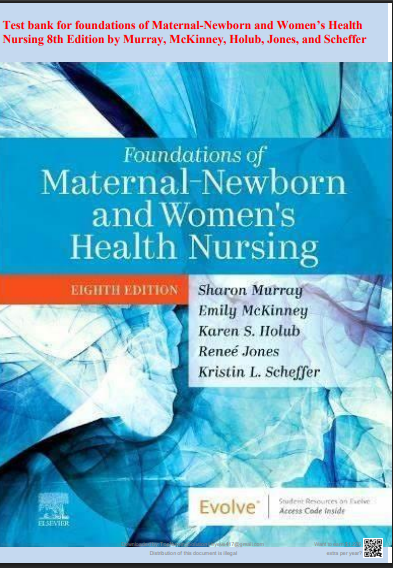
Maternal-newborn nursing asks you to keep two patients in mind at once, the parent and the baby, while also recognizing how quickly a normal pregnancy, labor, or newborn transition can shift into something that needs immediate intervention. That dual focus, combined with the pace at which things can change during labor and delivery, is exactly what makes this specialty so demanding to study for. This test bank was built around that challenge. It follows the chapter structure of Foundations of Maternal-Newborn and Women’s Health Nursing, 8th Edition, by Sharon Smith Murray, Emily Slone McKinney, Kristin Holub, Renee Jones, and Sandra Scheffer, so you can review antepartum, intrapartum, postpartum, and newborn content the same organized way the textbook presents it.
Whether you are in a maternal-newborn nursing course, preparing for clinical rotations on a labor and delivery or postpartum unit, or reviewing before the NCLEX-RN, this resource is designed to help you build the fast, dual-patient clinical judgment this specialty consistently requires.
What This Test Bank Covers
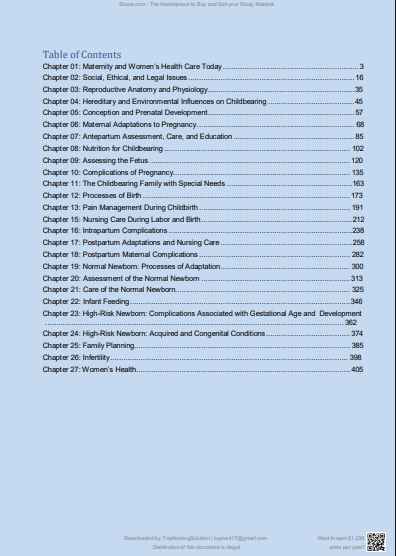
The question sets are organized to match the topics found throughout the textbook, including:
- Reproductive anatomy, physiology, and conception basics
- Antepartum assessment, fetal development, and prenatal care
- Common complications of pregnancy, including preeclampsia and gestational diabetes
- Labor and delivery, including fetal monitoring and stages of labor
- Pain management and comfort measures during labor
- Complications of labor and birth, including hemorrhage and abnormal labor patterns
- Postpartum physiological changes and postpartum complications
- Newborn transition, assessment, and common newborn concerns
- High-risk newborn conditions, including prematurity and congenital anomalies
- Women’s health topics, including reproductive health screening and family planning
- Family-centered care and cultural considerations across the maternity continuum
Each section includes a mix of multiple-choice, select-all-that-apply, and scenario-based questions, since these formats reflect how maternal-newborn nursing courses and licensure-style exams are typically structured.
Why Students Use a Test Bank Like This
Maternal-newborn exams often ask you to interpret a clinical picture quickly, like a fetal heart rate pattern, a postpartum bleeding assessment, or a set of newborn findings, and decide what it means and what to do next. That kind of applied, time-sensitive reasoning is hard to build just by reading. Practicing with well-written questions helps you:
- Practice interpreting fetal heart rate patterns and recognizing signs of fetal distress
- Build confidence recognizing early warning signs of postpartum hemorrhage and other complications
- Get comfortable distinguishing normal newborn findings from those that need further evaluation
- Strengthen prioritization skills when caring for both a parent and a newborn at the same time
- Reduce exam anxiety by practicing the same scenario-based reasoning used in course exams and licensure testing
Many students say this specialty is harder than it looks because so much can change quickly, and a finding that seems minor can actually be an early warning sign. Regular, chapter-based practice is one of the most effective ways to sharpen that recognition before it is tested for real.
What Makes This Test Bank Different
This test bank is built around full explanations, not shortcut answer keys. Every question includes a complete rationale that explains why the correct answer reflects safe, evidence-based maternal-newborn care, and why each incorrect option falls short, whether because it misses a warning sign, misinterprets a clinical finding, or is not the priority nursing action in that moment. This mirrors how maternal-newborn exams are typically written, since incorrect choices often sound plausible but miss a key detail in the scenario.
Questions are grouped by chapter and by phase of the maternity continuum, so you can focus your review exactly where you need it, whether that is a single topic like fetal monitoring before a quiz, or a full review before a comprehensive exam. It works well as a companion to assigned readings, a self-check before clinical rotations, or a structured review before exam day.
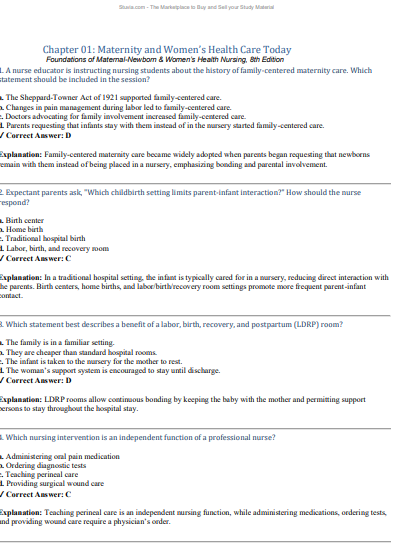
Sample Questions
Question 1
A nurse is monitoring a laboring patient and notices repetitive late decelerations on the fetal heart rate tracing. What is the nurse’s priority action?
A. Continue routine monitoring without intervention
B. Reposition the patient to her side and administer oxygen as indicated
C. Document the finding and reassess in one hour
D. Increase the rate of oxytocin infusion
Correct Answer: B
Rationale: Late decelerations are associated with uteroplacental insufficiency and reduced oxygen delivery to the fetus. Repositioning the patient, often to the left side, improves blood flow to the uterus, and administering oxygen helps increase fetal oxygenation, making this the appropriate priority action. Continuing routine monitoring without intervention ignores a concerning pattern that requires prompt action. Waiting an hour to reassess delays necessary intervention during a time-sensitive situation. Increasing oxytocin would worsen the situation, since oxytocin increases the frequency and strength of contractions, which can further reduce placental blood flow and worsen fetal oxygenation.
Question 2
A postpartum patient’s fundus is noted to be boggy and displaced above and to the right of the umbilicus. What should the nurse suspect and do first?
A. This is a normal postpartum finding and requires no action
B. A full bladder is likely displacing the uterus, and the nurse should assist the patient to void
C. This indicates the uterus is contracting appropriately
D. The patient should be prepared for immediate surgery
Correct Answer: B
Rationale: A boggy fundus displaced above and to the right of the umbilicus is a classic sign that a full bladder is preventing the uterus from contracting effectively. Assisting the patient to void often allows the uterus to return to the midline and regain proper tone, reducing the risk of postpartum hemorrhage. This finding is not normal and does require nursing action, ruling out the idea that no intervention is needed. A boggy, displaced fundus indicates the uterus is not contracting well, which is the opposite of appropriate uterine tone. Immediate surgery is not the first-line response to this common and usually easily correctable finding.
Question 3
A newborn is noted to have a yellow tint to the skin and sclera at 18 hours of age. What should the nurse recognize about this finding?
A. It is a normal finding at any time after birth and requires no follow-up
B. Jaundice appearing this early requires further evaluation, since physiologic jaundice typically appears after 24 hours
C. It indicates the newborn is dehydrated and needs increased formula feeding only
D. It is always caused by a maternal infection during pregnancy
Correct Answer: B
Rationale: Jaundice that appears within the first 24 hours of life is considered pathologic rather than physiologic, and it requires prompt further evaluation to identify the underlying cause, since early jaundice can be linked to conditions such as blood type incompatibility. Physiologic jaundice typically appears after the first 24 hours and follows a more predictable, benign pattern. Option A is incorrect because early-onset jaundice is not a normal, expected finding and should not be dismissed without evaluation. Option C oversimplifies the situation, since while hydration status can be assessed, this is not sufficient explanation or intervention for early jaundice on its own. Option D is inaccurate, since early jaundice has multiple possible causes, and maternal infection is not the only or most common explanation.
Question 4
A pregnant patient at 32 weeks gestation reports a sudden onset of severe headache, visual disturbances, and epigastric pain. Blood pressure is 162/108 mmHg. What condition should the nurse suspect?
A. Normal third-trimester discomfort
B. Preeclampsia with severe features
C. Round ligament pain
D. Braxton Hicks contractions
Correct Answer: B
Rationale: Severe headache, visual disturbances, epigastric pain, and significantly elevated blood pressure together are classic findings of preeclampsia with severe features, a serious pregnancy complication that requires prompt evaluation and treatment to prevent progression to eclampsia or other complications. These specific symptoms, especially in combination with markedly elevated blood pressure, go well beyond typical third-trimester discomfort. Round ligament pain presents as sharp, localized abdominal or groin pain related to uterine growth, not the systemic symptoms described here. Braxton Hicks contractions are irregular, generally painless practice contractions and do not explain this symptom pattern.
Question 5
A nurse is providing discharge teaching to a new parent about safe infant sleep practices. Which statement by the parent indicates a correct understanding of the teaching?
A. “I will place my baby on their stomach to sleep to prevent choking.”
B. “I will place my baby on their back on a firm mattress, without loose blankets or pillows.”
C. “I will let my baby sleep in the same bed as me every night for convenience.”
D. “I will place soft bumper pads in the crib for extra cushioning.”
Correct Answer: B
Rationale: Placing an infant on their back on a firm mattress, without loose blankets, pillows, or other soft items, is the recommended safe sleep practice to reduce the risk of sudden infant death syndrome (SIDS) and suffocation. Placing a baby on their stomach to sleep is not recommended and actually increases SIDS risk rather than preventing choking. Bed-sharing increases the risk of suffocation and is generally discouraged in favor of room-sharing with a separate, safe sleep surface. Soft bumper pads pose a suffocation risk and are not recommended as part of safe crib setup.
Frequently Asked Questions
Is this test bank the same as the official instructor materials from the publisher?
This test bank is an independently prepared study resource built to help students review the topics covered in the 8th edition of Foundations of Maternal-Newborn and Women’s Health Nursing. It is intended as a self-study companion and is not distributed by the publisher.
Is this test bank helpful for NCLEX-RN preparation?
The questions are written in a scenario-based style similar to licensure-exam questions, with an emphasis on recognizing complications, prioritizing care, and applying safe maternal-newborn nursing practice, all of which are heavily tested areas on the NCLEX-RN.
Does it cover every chapter of the textbook?
Yes, the questions are organized by chapter and by phase of the maternity continuum, following the general topic order of the 8th edition, from reproductive physiology through postpartum and newborn care.
What question formats are included?
Most questions are multiple-choice, with some select-all-that-apply and scenario-based items, since these formats are common in maternal-newborn nursing courses and on licensure-style exams.
Do the answers include explanations, or just the correct letter?
Yes, every question includes a full rationale explaining why the correct answer reflects safe, evidence-based care and why the other options fall short.
Who is this test bank best suited for?
It is designed for nursing students taking a maternal-newborn or women’s health nursing course, as well as anyone reviewing antepartum, intrapartum, postpartum, and newborn care principles ahead of an exam.
How should I use this resource while studying?
A common approach is to read the assigned chapter first, then work through the related questions without checking the answers right away. Afterward, review the rationales closely, especially for missed questions, since recognizing why a finding is concerning matters more than memorizing the correct letter alone.
Can this replace reading the textbook?
No. This resource works best alongside the textbook, not instead of it. The textbook builds your foundational understanding of maternal, newborn, and women’s health concepts, while the test bank helps you practice applying that knowledge to realistic clinical scenarios.
Is the content aligned specifically with the 8th edition?
Yes, the material follows the topics, terminology, and chapter organization used in the 8th edition of the textbook.
Is this useful for last-minute exam review?
Yes, many students use it as a focused review tool in the days before an exam, since the chapter-based organization makes it easy to target specific topics, like labor complications or newborn assessment, quickly, rather than reviewing the entire book at once.


Reviews
There are no reviews yet.