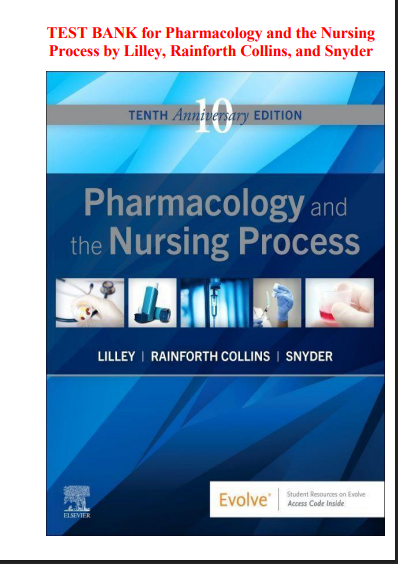
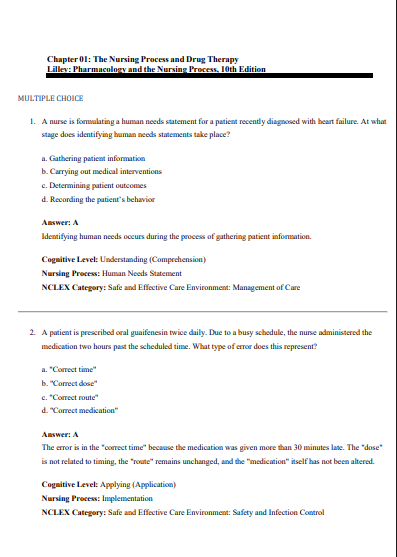
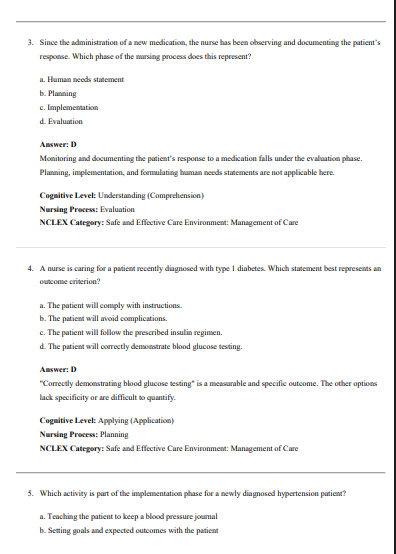
Pharmacology courses can feel like an avalanche of drug names, but Pharmacology and the Nursing Process has always stood out for tying every drug back to something more useful: the nursing process itself. Instead of learning medications in isolation, the textbook teaches you to think through assessment, planning, implementation, and evaluation for every drug class you study. This test bank was built to reinforce exactly that approach. It follows the chapter structure of Pharmacology and the Nursing Process, 10th Edition, by Linda Lane Lilley, Julie S. Snyder, and Shelly Rainforth Collins, so your practice mirrors the nursing-process framework the textbook is known for.
Whether you are in your first pharmacology course, reviewing before a unit exam, or preparing for the NCLEX-RN, this resource is designed to help you apply pharmacology the way it will actually be tested and the way it will actually be used at the bedside.
What This Test Bank Covers
The question sets are organized to match the topics found throughout the textbook, including:
- Foundational pharmacology concepts, including pharmacokinetics and pharmacodynamics
- Application of the nursing process to safe medication administration
- Legal, ethical, and cultural considerations in medication therapy
- Medications for the cardiovascular, renal, and hematologic systems
- Medications for the respiratory and gastrointestinal systems
- Anti-infective, antiviral, and antifungal medications
- Pain management, including opioid and non-opioid analgesics
- Endocrine medications, including insulin and other antidiabetic agents
- Psychotropic medications and central nervous system drugs
- Medications for special populations, including pediatric, pregnant, and older adult patients
- Patient education, adverse effects, and medication safety principles
Each section includes a mix of multiple-choice, select-all-that-apply, and case-based questions, since these formats reflect how pharmacology courses using this text are typically taught and tested.
Why Students Use a Test Bank Like This
This textbook’s biggest strength, tying pharmacology to the nursing process, is also exactly what most exam questions are built around. Instead of asking what a drug does, questions often ask what the nurse should assess before giving it, what to monitor during therapy, or what to teach the patient before discharge. Practicing with well-written questions helps you:
- Apply each phase of the nursing process to specific medications and drug classes
- Build confidence recognizing priority assessments before administering high-risk medications
- Practice identifying appropriate patient teaching points for common drug therapies
- Get comfortable with questions that connect a drug’s action to a nursing intervention or evaluation criterion
- Reduce exam anxiety by practicing the same nursing-process-based reasoning the textbook itself is built around
Many students say they understand pharmacology facts just fine but struggle to translate them into nursing actions on an exam. Regular, chapter-based practice is one of the most effective ways to close that gap between “knowing the drug” and “knowing what to do with that knowledge.”
What Makes This Test Bank Different
This test bank is built around full explanations, not shortcut answer keys. Every question includes a complete rationale that explains why the correct answer reflects appropriate application of the nursing process to that medication, and why each incorrect option falls short, whether because it skips an assessment step, misses a safety concern, or is not the priority nursing action. This mirrors how exams using this textbook are typically written, since incorrect choices are often reasonable-sounding actions that simply are not the best fit for that specific step of care.
Questions are grouped by chapter and by drug category, so you can focus your review exactly where you need it, whether that is a single drug class before a quiz or a full review before a comprehensive final. It works well as a companion to assigned readings, a self-check before clinical rotations, or a structured review before exam day.
Sample Questions
Question 1
Before administering a loop diuretic to a patient with heart failure, which assessment is most important for the nurse to complete first?
A. Check the patient’s most recent potassium level
B. Ask the patient about their favorite foods
C. Measure the patient’s height
D. Review the patient’s visitor list for the day
Correct Answer: A
Rationale: Loop diuretics increase potassium excretion, which can lead to hypokalemia, a potentially dangerous electrolyte imbalance. Checking the most recent potassium level before administration allows the nurse to identify a low level and notify the provider if needed before giving a medication that could worsen the imbalance. Asking about favorite foods, measuring height, and reviewing a visitor list are not relevant safety assessments tied to the pharmacologic action of this specific drug class and would not appropriately guide safe administration.
Question 2
A patient begins therapy with an oral anticoagulant. Which nursing action reflects the evaluation phase of the nursing process related to this medication?
A. Teaching the patient to watch for signs of unusual bruising or bleeding
B. Reviewing laboratory results, such as INR, to determine whether the drug is achieving the desired therapeutic effect
C. Administering the first dose of the medication as prescribed
D. Assessing the patient’s baseline bleeding risk before starting therapy
Correct Answer: B
Rationale: The evaluation phase of the nursing process involves determining whether an intervention, in this case anticoagulant therapy, is achieving its intended outcome. Reviewing relevant lab values, such as INR for warfarin therapy, allows the nurse to evaluate whether the medication is working as intended and whether the dose needs adjustment. Teaching the patient about bleeding precautions reflects the implementation phase, since it is an action taken during ongoing care. Administering the first dose is also part of implementation, not evaluation. Assessing baseline bleeding risk before starting therapy reflects the assessment phase, which occurs before the intervention begins, not after it has already started.
Question 3
A patient with a documented penicillin allergy is prescribed a cephalosporin antibiotic. What is the nurse’s priority action before administering this medication?
A. Administer the medication as prescribed without further action
B. Notify the provider and discuss the potential for cross-sensitivity before giving the dose
C. Give a lower dose of the medication to reduce reaction risk
D. Give the medication only if the patient specifically requests a different drug
Correct Answer: B
Rationale: Cephalosporins carry a risk of cross-sensitivity in patients with a penicillin allergy due to similarities in their chemical structure. Before administering the dose, the nurse should notify the provider and discuss this risk so an informed decision can be made about whether to proceed, choose an alternative, or take additional precautions. Simply administering the medication without addressing this known risk could expose the patient to a serious allergic reaction. Reducing the dose does not eliminate the risk of a cross-reaction and is not an appropriate way to manage a known allergy concern. Waiting for the patient to request a different drug places responsibility on the patient rather than the nurse, who has a professional duty to identify and act on this safety concern.
Question 4
Which patient statement indicates a need for further teaching about their newly prescribed metformin therapy?
A. “I will take this medication with food to help reduce stomach upset.”
B. “I should stop taking this medication several days before a scheduled CT scan with contrast dye, if my provider advises it.”
C. “I can stop taking this medication once my blood sugar returns to a normal range.”
D. “I will monitor for symptoms like nausea, unusual fatigue, or abdominal pain and report them.”
Correct Answer: C
Rationale: Metformin is generally intended for long-term management of type 2 diabetes, and stopping the medication simply because blood sugar has improved reflects a misunderstanding, since discontinuing therapy without provider guidance could lead to a return of hyperglycemia. This statement indicates a need for further teaching. Taking the medication with food to reduce gastrointestinal upset is accurate patient teaching and does not indicate misunderstanding. Awareness of the need to potentially hold metformin before contrast dye procedures reflects correct understanding of an important safety consideration related to kidney function. Monitoring for symptoms like nausea, fatigue, or abdominal pain, which can indicate a rare but serious complication called lactic acidosis, also reflects accurate and appropriate patient understanding.
Question 5
A nurse is planning care for a patient starting opioid therapy for postoperative pain. Which nursing diagnosis is most appropriate to include in the plan of care related to this medication?
A. Risk for constipation related to opioid use
B. Risk for hyperthermia related to opioid use
C. Risk for hypertension related to opioid use
D. Risk for hyperglycemia related to opioid use
Correct Answer: A
Rationale: Opioid medications commonly slow gastrointestinal motility, making constipation one of the most frequent and clinically significant side effects associated with opioid therapy. Including a nursing diagnosis related to this risk allows the care plan to address prevention strategies, such as increased fluid intake, activity, and possibly a bowel regimen. Opioids are more commonly associated with respiratory depression and sedation rather than hyperthermia, making that option a less relevant concern tied to opioid use specifically. Opioids typically cause hypotension rather than hypertension, making that option inaccurate as well. Hyperglycemia is not a typical or expected effect of opioid therapy, making it an inappropriate primary nursing diagnosis for this specific medication.
Frequently Asked Questions
Is this test bank the same as the official instructor materials from the publisher?
This test bank is an independently prepared study resource built to help students review the topics covered in the 10th edition of Pharmacology and the Nursing Process. It is intended as a self-study companion and is not distributed by the publisher.
Is this test bank helpful for NCLEX-RN preparation?
The questions are written in a nursing-process-based style similar to licensure-exam questions, with an emphasis on assessment, priority actions, and patient teaching, all of which are heavily tested areas in pharmacology.
Does it cover every chapter of the textbook?
Yes, the questions are organized by chapter and drug category, following the general topic order of the 10th edition, from foundational pharmacology principles through medications for each major body system and special population.
What question formats are included?
Most questions are multiple-choice, with some select-all-that-apply and case-based items, since these formats are common in pharmacology courses that use this text and reflect its nursing-process framework.
Do the answers include explanations, or just the correct letter?
Yes, every question includes a full rationale explaining why the correct answer reflects appropriate application of the nursing process and why the other options fall short.
Who is this test bank best suited for?
It is designed for nursing students taking a pharmacology course using this textbook, as well as anyone reviewing foundational drug concepts and nursing-process application ahead of an exam.
How should I use this resource while studying?
A common approach is to read the assigned chapter first, then work through the related questions without checking the answers right away. Afterward, review the rationales closely, especially for missed questions, since understanding how each nursing-process phase applies to a medication matters more than memorizing the correct letter alone.
Can this replace reading the textbook?
No. This resource works best alongside the textbook, not instead of it. The textbook builds your foundational understanding of pharmacology concepts within the nursing-process framework, while the test bank helps you practice applying that knowledge to realistic scenarios.
Is the content aligned specifically with the 10th edition?
Yes, the material follows the topics, terminology, and chapter organization used in the 10th edition of the textbook.
Is this useful for last-minute exam review?
Yes, many students use it as a focused review tool in the days before an exam, since the chapter-based organization makes it easy to target specific drug categories quickly, rather than reviewing the entire book at once.


Reviews
There are no reviews yet.